
Top 10 Himalayan Salt Exporters in Pakistan: A 2026 Sourcing Guide
TL;DR
- Pakistan supplies most of the world’s Himalayan pink salt.
- All of it comes from the Khewra Salt Mine in Punjab.
- This guide compares 10 established exporters side by side.
- Each one suits a different kind of buyer.
- Certifications matter more than price at wholesale volume.
- Always approve a sample before a bulk order.
- Scroll to the Buyer-Fit Matrix to shortlist fast.
If you are sourcing Himalayan pink salt, you will end up buying from Pakistan. Almost every supplier in the world traces back to one mine there.
This guide is for US importers, wholesalers, private-label brands, retailers and distributors. Below you will find a comparison of ten established Himalayan salt manufacturers in Pakistan, what certifications actually mean, and how to approach them for a wholesale order.
This blog is about a list of Pakistani companies exporting Himalayan salt internationally.
Pakistan’s Position in the Global Salt Trade
According to trade data platform Volza, Pakistan leads the global Himalayan salt trade under HS code 2501, with 9,884 shipments and roughly a 67% share.
India follows at around 14% and Malaysia at about 7%. Much of the volume shipped from India and Malaysia is re-exported salt of Pakistani origin.
So Pakistan is roughly tenth in salt overall, but close to two-thirds of the Himalayan segment.
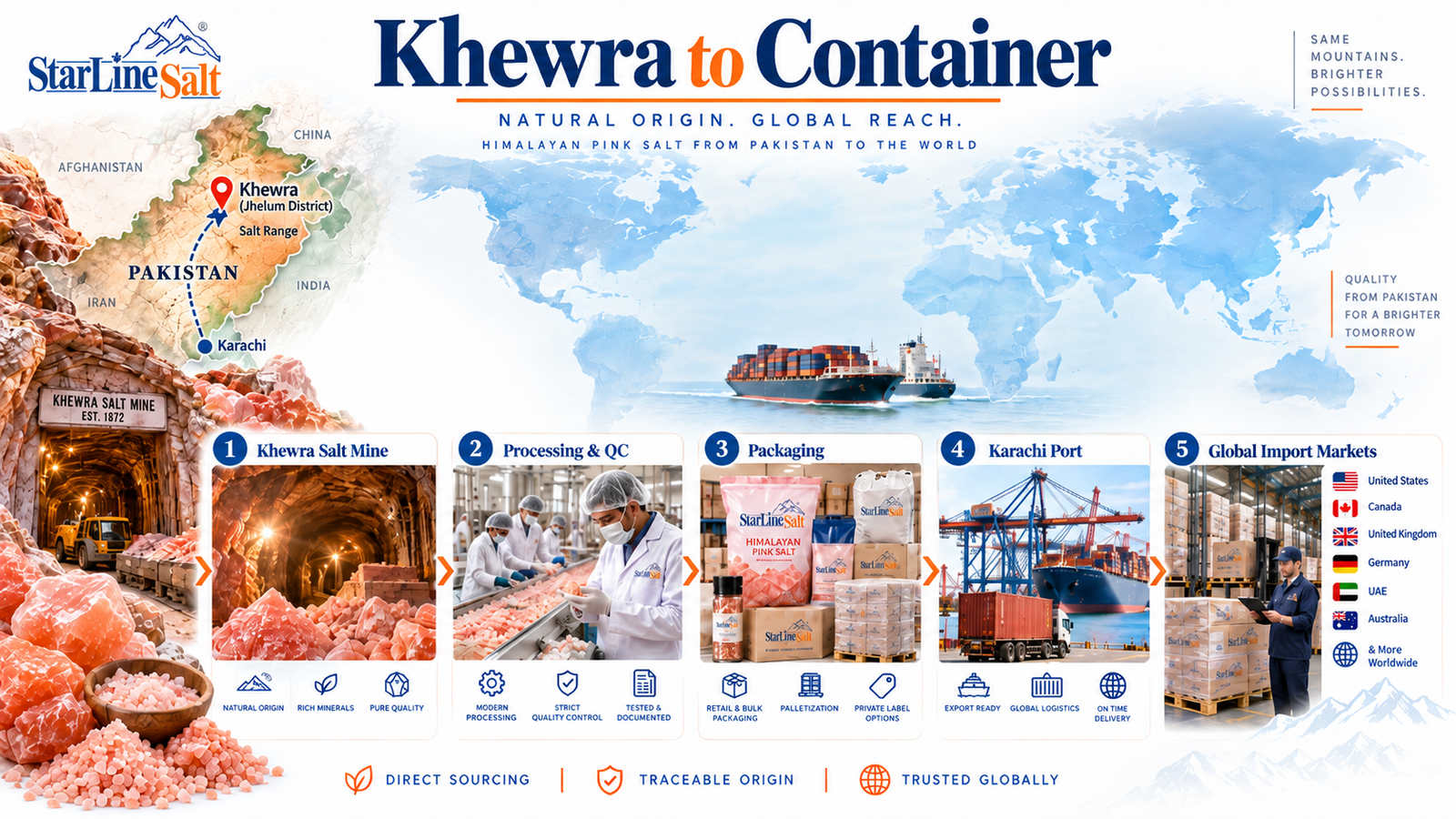
That position rests on geology. The Khewra Salt Mine sits in the Salt Range of Jhelum District, Punjab. It is one of the oldest and largest rock salt deposits on earth. The distinctive pink colour comes from the trace mineral composition of the deposit, mainly iron oxide alongside small amounts of other minerals.
The Trade Development Authority of Pakistan (TDAP) has highlighted Geographical Indication (GI) protection for Pakistan’s Pink Rock Salt as a way to strengthen international recognition and support export value.
For buyers, the practical takeaway is simple. Buying closer to Khewra usually means better pricing and clearer traceability.
Top 10 Himalayan Salt Exporters in Pakistan
Here is a side-by-side view, followed by a short profile of each company.
| Company | HQ | Est. | Certifications | Product Focus | Key markets | Best for |
| StarlineSalt | Karachi | 2001 | CE & UL (lamps); food-grade standards | Lamps, edible (fine/coarse/custom), salt blocks, décor; animal & horse licks | USA, UK, Australia, NZ, South Korea, Malaysia, Japan, Singapore,Hong Kong, Indonesia, Vietnam, Taiwan, Italy, Spain, Canada | Lamps, equine/livestock licks, private label |
| Ittefaq Salt | Lahore | 1983 | BRC AA+ grade facility, Halal, Kosher | Edible, bath salt, wellness, décor, animal lick; vertically integrated mining→export | 90+ countries; top US port New York | Private label at GFSI standard; US retail |
| Sana Salt | Karachi | 2002 | ISO 22000:2005, BRCGS, Halal, Kosher, FDA | Himalayan pink salt range | 15+ international trade fairs | Himalayan salt products, wellness products, private-label |
| Ghani Himalayan Salt | Near Khewra | Group legacy 60+ years | ISO and HACCP certified production units | Food-grade, spa salts, lamps, bricks, tiles, animal licks; also largest industrial salt producer, | Germany, France, Netherlands, wider EU; USA | Very large bulk volumes; EU compliance |
| HubSalt | Karachi | 1986 | ISO 9001:2015, BRC, HACCP, GMP, Halal, Kosher, and SA8000 | Industrial-grade and edible salt | Global | Industrial + refined food salt at scale |
| Standard Salt | Lahore | 1999 | BRCGS, FSSC 22000, FDA, Halal, Kosher, GMP, HACCP, and ISO 9001:2015 | Bulk pink rock salt | US, Japan, Vietnam, Europe (self-reported) | Bulk and wholesale distribution |
| Unique Minerals | Lahore | 18+ years | ISO, HACCP, Halal, and FDA | Blocks, edible, décor, bath, industrial & livestock | 80+ countries; 10,000+ MT exported annually; 250+ private-label partners | High-volume private label |
| Agro Hub International | Karachi | 2002 | BRC, ISO 22000:2018, HACCP, Halal, Kosher, BSCI, SEDEX. | Himalayan + sea salt; fully automated stainless-steel edible line | Worldwide | Automated food-grade processing; port-adjacent |
| Al-Azeem Enterprises | Karachi | 1998 | ISO 9001:2015, ISO 14001:2015, ISO 22000, HACCP, GMP, BRC, FDA, Kosher | Himalayan edible salt, décor, wellness products, salt bricks, animal lick salt, industrial salt | USA, Central & South America, UK, Europe, Far East | Bulk Himalayan salt, private label, diverse salt products |
| RBK International | Karachi | 2017 | ISO 9001, Halal, HACCP, FDA | Himalayan pink salt, salt lamps, bath salt, salt tiles, animal salt licks | USA, Canada, Colombia, Australia, Turkey, China, Kenya, India, UAE | Bulk Himalayan salt, private label, salt lamps |
1. StarlineSalt
StarlineSalt is based in Karachi and was established in 2001. Starline offers a wide variety of Himalayan salt products, including salt lamps, decorative lamp shapes, edible salt in fine, coarse and custom grinds, salt blocks and bricks, bath and spa lines, and animal and horse licks.
Its lamps carry CE and UL certification, and its edible lines are produced to food-grade standards. Popular categories include the classic pink salt lamp, novelty designs like the turtle shaped salt lamp and bird shaped salt lamp, Himalayan gourmet salt for retail and foodservice, and animal lick salt for equine and livestock buyers.
The company also handles private label Himalayan salt programmes and ships to the USA, UK, Australia, New Zealand, South Korea, Japan, Singapore, Hong Kong, Malaysia, Indonesia, Vietnam, Taiwan, Italy, Spain and Canada.
2. Ittefaq Salt
Ittefaq Salt operates from Lahore and has been running since 1983. It is one of the oldest names in the trade. The company runs a BRC AA+ grade facility and is GFSI-integrated, with Halal and Kosher certification. Product lines cover edible salt, bath salt, wellness items, décor and animal licks. It reports supply to more than 90 countries, with New York as its top US port.
3. Sana Salt
Sana Salt is a Karachi-based exporter founded in 2002. It focuses on the Himalayan pink salt range rather than industrial salt. Certifications include ISO 22000:2005, BRCGS, Halal and Kosher, plus FDA registration. The company has taken part in more than 15 international trade fairs, which suggests an active export-facing sales team.
4. Ghani Himalayan Salt
Ghani sits near Khewra itself, which is about as close to the source as a supplier gets. The wider Ghani group carries more than 60 years of legacy in the sector. Production units are ISO and HACCP certified. The range spans food-grade salt, spa salts, lamps, bricks, tiles and animal licks, and the group is also one of Pakistan’s largest industrial salt producers. Key markets include Germany, France, the Netherlands, the wider EU and the USA.
5. HubSalt
HubSalt was established in Karachi in 1986. It works across both industrial-grade and edible salt at significant scale. Its certification list is broad: ISO 9001:2015, BRC, HACCP, GMP, Halal, Kosher and SA8000. That last one is a social accountability standard, which matters to buyers with supplier ethics requirements.
6. Standard Salt
Standard Salt operates from Lahore and was founded in 1999. It concentrates on bulk pink rock salt rather than a wide retail catalogue. Its reported certifications are extensive, covering BRCGS, FSSC 22000, FDA, Halal, Kosher, GMP, HACCP and ISO 9001:2015. Self-reported markets include the US, Japan, Vietnam and Europe.
7. Unique Minerals
Unique Minerals is based in Lahore with more than 18 years in the trade. The company lists over 14 certifications. Its range covers blocks, edible salt, décor, bath products, industrial salt and livestock licks. It reports exports to more than 80 countries, over 10,000 metric tons shipped annually, and more than 250 private-label partners.
8. Agro Hub International
Agro Hub International started in Karachi in 2002. It handles both Himalayan salt and sea salt. Its edible line runs on a fully automated stainless-steel processing setup, which helps with hygiene control and batch consistency. Being port-adjacent in Karachi can shorten inland transit time.
9. Al-Azeem Enterprises
Al-Azeem Enterprises was established in Karachi in 1998. Its certification list is one of the broadest here: ISO 9001:2015, ISO 14001:2015, ISO 22000, HACCP, GMP, BRC, FDA and Kosher. The ISO 14001 environmental standard is less common in this sector. Products include edible salt, décor, wellness items, salt bricks, animal lick salt and industrial salt. Markets span the USA, Central and South America, the UK, Europe and the Far East.
10. RBK International
RBK International is the newest company on this list, founded in 2017. It holds ISO 9001, Halal, HACCP and FDA registration. Its catalogue covers Himalayan pink salt, salt lamps, bath salt, salt tiles and animal salt licks. Reported markets include the USA, Canada, Colombia, Australia, Turkey, China, Kenya, India and the UAE.
Which Exporter Fits Your Order?
Shortlisting gets easier when you start from your own order, not from the supplier list. Match your situation to the row below, then check that against the comparison table above.
| Buyer need | What to check |
| Bulk food-grade, 100+ MT | FSSC/BRCGS, granulation control, silo capacity |
| Salt lamps for retail | CE/UL certification, breakage policy, carton spec |
| Animal / horse licks | Compressed vs natural block, rope + drilled hole, feed-grade cert |
| Private label / OEM | Artwork support, packaging MOQ, lead time |
| First-time / trial order | Low MOQ, LCL willingness, sample policy |
A supplier who is excellent for one row may be a poor fit for another. A large bulk food producer rarely wants to chase a 200-unit lamp order, and a lamp specialist may not hold silo capacity for 100 metric tons of granulated salt.
What Are the Common Certifications for Exporting Himalayan Salt from Pakistan?
Certifications tell you whether a supplier has systems in place, not just good intentions. Here is what the common ones actually mean.
Food safety standards
- BRCGS and FSSC 22000 — the two main GFSI-recognised food safety schemes. Most large US and EU retailers expect one of these for edible salt.
- HACCP — a hazard control system. Usually the baseline, not the ceiling.
- ISO 22000 — food safety management. Often held alongside HACCP.
- GMP — good manufacturing practice covering hygiene and process control.
Quality and management standards
- ISO 9001:2015 — general quality management.
- ISO 14001:2015 — environmental management.
- SA8000 — social accountability and labour conditions.
Market and religious certifications
- Halal and Kosher — needed for specific retail and foodservice channels.
- CE and UL — electrical safety marks for salt lamps. These are not optional for US retail. Lamps are wired products, and a retailer will ask.
One important clarification on FDA
The FDA does not “certify” companies. Foreign food facilities register with the FDA, and importers file prior notice for food shipments. When a supplier says “FDA certified,” ask them to confirm they mean facility registration. It is a common wording slip rather than a red flag, but it is worth checking.
Geographical Indication (GI)
GI is not a supplier certification. It is a country-level protection TDAP has pursued for Pakistan’s Pink Rock Salt. It affects branding rights, not factory standards.
How to Contact Himalayan Salt Exporters in Pakistan for Wholesale Orders
A clear first email gets a faster, more useful reply. Vague enquiries usually get a generic price list.
Follow this sequence:
- Write your spec first. Product type, grain size or dimensions, quantity, packaging format, and destination port.
- Send the same enquiry to three or four suppliers. Comparing replies tells you a lot about who reads carefully.
- Ask for a certificate pack. Request the actual documents, not a list of logo images.
- Ask about MOQ and lead time separately for standard and private-label versions. They are rarely the same.
- Request samples and pay for the courier. Free-sample requests get deprioritised.
- Check the response quality. A supplier who asks you clarifying questions about tolerances usually runs a tighter factory.
- Start with a trial order. A pallet or LCL shipment before a full container is cheap insurance.
- Agree tolerances in writing for colour, weight and dimensions before production starts.
Most Pakistani exporters respond within one to two business days. Note the time difference: Pakistan is roughly 9 to 12 hours ahead of US time zones depending on season.
Frequently Asked Questions
- Where does Himalayan pink salt actually come from?
It comes from the Khewra Salt Mine in the Salt Range, Jhelum District, Punjab, Pakistan. It is the second-largest salt mine in the world and the source of nearly all genuine Himalayan pink salt sold globally. - Why is Himalayan salt pink?
The colour comes from the trace mineral composition of the deposit. Iron oxide is the main contributor. Shade varies naturally from batch to batch, which is why commercial buyers should agree to an acceptable colour range in advance. - What certifications should a Himalayan salt exporter have?
For edible salt, look for BRCGS or FSSC 22000, plus HACCP and ISO 9001. For salt lamps sold in the US, CE and UL marks are essential. Halal and Kosher matter for certain retail channels. - What is the minimum order quantity for wholesale Himalayan salt products?
It varies by product and supplier. Bulk edible salt is usually quoted by the metric ton or by container. Lamps and décor are quoted by unit or carton. Private-label orders normally carry higher minimums because of printing and tooling setup costs. - Can Pakistani exporters handle private labels for US brands?
Yes. Private label is a standard offering across most of the companies listed here. Confirm artwork support, packaging MOQ, lead time and whether the supplier can supply compliant US label text for food products.
Key Takeaways
Pakistan is the origin point for the global Himalayan pink salt trade, and Khewra is the origin point within Pakistan. That concentration means your supplier choice is less about geography and more about fit.
Match the exporter to your order type. Check certifications that are relevant to your channel rather than counting logos. Then approve a physical sample before committing to volume.
If you are still narrowing your shortlist, the most useful next step is to write a one-page spec and send it out. Share your product type, quantity, packaging preference and destination port with the StarlineSalt team, and ask for samples alongside the certificate pack. A short conversation about tolerances now saves far more than it costs later.