
10 Different Salts for Cooking: Which One Should You Choose?
Different salts for cooking serve different jobs. For most dishes, pick kosher salt or Himalayan pink salt. For baking, use fine table salt. For a final crunch, sprinkle on flake salt or smoked salt.
Each salt differs in grain size, mineral content, and taste. Therefore, one jar cannot fit every recipe.
This guide explains the different types of edible salt and shows you how to pick the right one. Additionally, it shares sodium tips for people with high blood pressure.
Which Salt Fits Your Dish?
Use this short list when you are in a hurry.
- Everyday cooking: kosher salt or Himalayan pink salt
- Baking: fine table salt
- Soups, vegetables, and seafood: sea salt
- Pickles and brines: pickling salt
- Finishing a dish: flake salt or smoked salt
- South Asian dishes: Himalayan black salt (kala namak)
Different Salts for Cooking: 10 Types and Their Uses
Here are the different types of salts used in cooking. Each one has its own texture, taste, and best use.
1. Table Salt
Table salt is the most common salt in homes. Makers refine it and grind it into tiny, even grains. Most brands add iodine, which helps prevent iodine deficiency. They also add an anti-caking agent, which stops clumps.
Table salt dissolves fast, so it works well in baking. Most recipes also assume you use it. However, it can taste sharp. Therefore, add it slowly to soups and sauces.
2. Sea Salt
Sea salt comes from evaporated seawater. Producers refine it less than table salt. As a result, it keeps small amounts of minerals like magnesium and calcium. However, these amounts stay tiny, so they add little nutrition.
Sea salt comes in fine and coarse grains. Most kinds have no added iodine. Use fine sea salt in soups, vegetables, and seafood. Additionally, coarse sea salt works well in a grinder.
3. Himalayan Pink Salt
Himalayan pink salt is rock salt. Miners dig it from the Khewra Salt Mine in Punjab, Pakistan. Tiny amounts of minerals, such as iron, give it a pink color. Workers wash it and crush it into different grain sizes.
It tastes mild and clean. Therefore, it suits meat, vegetables, soups, and salads. Its pink color also makes food look better. Like sea salt, it usually has no added iodine.
StarlineSalt offers gourmet himalayan pink salt in several grain sizes.
For example, Himalayan Pink Salt Fine Grains suit baking and sauces. Meanwhile, Himalayan Pink Salt 2-5 mm Grains work well in grinders and marinades. For a deeper color, try Himalayan Dark Pink Salt Granules 2-5 mm.
You can read our guide on how to use himalayan salt in cooking.
4. Himalayan Black Salt (Kala Namak)
Himalayan black salt, or kala namak, is a South Asian favorite. Traditionally, makers heat rock salt with charcoal and herbs. The result has a strong, egg-like smell and taste.
Cooks sprinkle it on chaat, raita, chutney, and fruit. Moreover, vegans add it to tofu scramble for an egg-like flavor. Use only a small pinch, because the taste is strong.
StarlineSalt sells:
Himalayan Black Salt Granules 1-2mm
Himalayan Black Salt Granules 2-5mm
5. Kosher Salt
Kosher salt has large, flaky crystals. Chefs like it because they can pinch it easily. Most brands have no iodine. The name comes from the Jewish practice of koshering meat.
Kosher salt seasons meat, roasts, and vegetables well. However, measure with care. A teaspoon of kosher salt holds less salt than a teaspoon of table salt.
6. Flake Salt (Finishing Salt)
Flake salt has thin, crisp, uneven flakes. Cooks add it at the end, not during cooking. It gives a clean taste and a light crunch.
Because the flakes melt slowly, they keep their crunch on warm food. Try flake salt on steak, eggs, salads, and chocolate desserts.
7. Pickling Salt
Pickling salt is fine and pure. It has no iodine and no anti-caking agents. Therefore, it keeps pickle brine clear.
Use it for pickles, brines, and fermenting vegetables. However, skip it for finishing, because it adds no texture.
8. Celtic Sea Salt
Celtic sea salt comes from the coast of Brittany, France. Workers rake it by hand from clay-lined salt ponds. The clay gives the crystals a light grey color.
The crystals stay moist and taste briny. This salt suits soups, stews, and roasted vegetables.
9. Alaea Salt (Red Hawaiian Salt)
Alaea salt is a red Hawaiian salt. Makers mix sea salt with red volcanic clay. The clay holds iron, which gives the salt its red color.
It tastes mild and feels crunchy. Cooks use it on poke, grilled fish, meat, and salads.
10. Smoked Salt
Smoked salt is sea salt dried slowly over burning wood. It carries a deep, smoky taste. Treat it as a flavor booster, not an everyday salt.
Add a pinch to grilled steak, roasted potatoes, marinades, or smoky stews. A tiny pinch on dark chocolate also tastes good.
Cooking Salt vs. Finishing Salt
Not every salt belongs at the same stage of cooking. Cooking salts go in early. Finishing salts go on last.
Cooking salts include table, kosher, sea, and Himalayan pink salt. Their grains dissolve and spread evenly. Therefore, add them early to season soups, pasta water, and bread dough.
Finishing salts include flake and smoked salt. They do not dissolve fully, so they give a salty crunch and bold flavor. For example, sprinkle a pinch over steak just before serving.
Which Salt Pairs Best With Which Food?
Salt boosts flavor in every dish. However, the right type makes a bigger difference.
- Meat, poultry, and fish: kosher salt or sea salt before roasting or grilling
- Soups, vegetables, and pasta water: sea salt or kosher salt
- Bread and cookies: fine table salt
- Radishes and boiled eggs: Himalayan pink salt
- Grilled steak and roasted potatoes: smoked salt
- Chutney, raita, and fruit: Himalayan black salt
- Pickles and brines: pickling salt
- Grilled fish and poke: alaea salt
How to Choose the Best Type of Salt for Cooking
The best type of salt for cooking depends on your dish, your taste, and your health needs. Use these simple checks.
Choose by Taste
Want a clean, salty taste? Pick table salt or kosher salt. Want a mild, rounded taste? Try Himalayan pink salt or sea salt. Want a bold flavor? Pick smoked salt or black salt.
Choose by Grain Size
Grain size changes how salt dissolves and how it feels in your hand. Fine salt dissolves fast and seasons evenly. Coarse salt gives you more control and a little crunch.
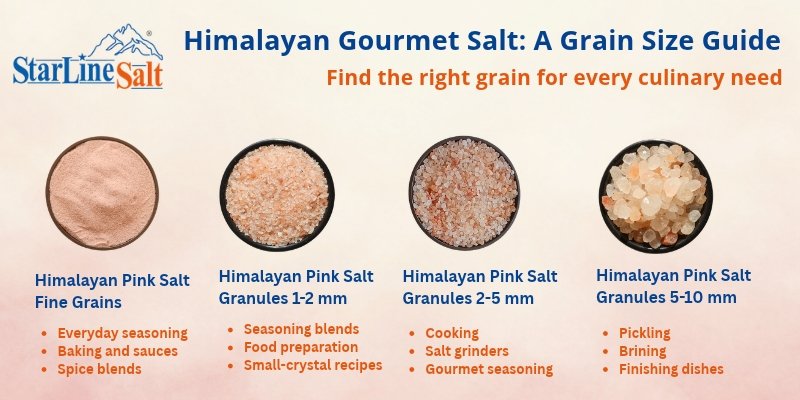
Choose the Right Himalayan Salt Grain Size
Find the right crystal size for your cooking, seasoning, and food processing needs. StarlineSalt’s gourmet range covers the first four sizes below.
Looking for the best gourmet salt for your kitchen? Start with the grain size that matches your main use. Then pick the color and flavor you like.
| Grain Size | What it looks like | Best Uses |
| Fine Salt | Powder-like, tiny crystals | Baking, soups, sauces, seasoning benefits |
| 1-2mm | Small, distinct granules | Spice blends, food processing, everyday seasoning |
| 2-5mm | Medium sized crystals | Grinders, marinades, general cooking |
| 5-10mm | Large, coarse crystals | Brining, pickling, grinders, salt crusts |
| Larger Crystal or Speciality Cuts | Chunky or irregular pieces | Depends on the product |
Best Type of Salt for High Blood Pressure
Many readers ask about the best type of salt for high blood pressure. The honest answer is simple. No salt is sodium-free. Every common salt can raise blood pressure when you eat too much.
Himalayan pink, sea, and kosher salt contain about the same sodium as table salt by weight. Their minerals appear in tiny amounts. Therefore, those minerals do not cancel out the sodium.
Try these simple steps:
- Measure salt with a spoon instead of pouring from the jar.
- Add lemon, herbs, garlic, and spices for extra flavor.
- Sprinkle coarse salt on top at the end. It hits your tongue first, so you may need less.
- Check labels on packaged foods, because they carry much of your daily sodium.
- Ask your doctor before you try a lower-sodium salt substitute.
This guide shares general information, not medical advice.
Common Salt Myths
- Myth: Himalayan salt has far less sodium. Fact: Sodium levels stay close to table salt by weight.
- Myth: Sea salt always has iodine. Fact: Most sea salt has none unless the label says so.
- Myth: Mineral salts work like supplements. Fact: They hold minerals only in tiny amounts.
- Myth: All salts taste the same. Fact: Grain size and minerals change taste and texture.
Cook With StarlineSalt Himalayan Gourmet Salt
StarlineSalt sources Himalayan pink salt from the Khewra Salt Mine in Pakistan. The company has served buyers in 36+ countries since 2001. Its gourmet range includes pink, dark pink, and black salt in several grain sizes.
Moreover, each batch carries a health certificate that confirms Codex Alimentarius compliance. Browse the full gourmet salt collection and pick the size that fits your kitchen.
Frequently Asked Questions
1. Can I swap one salt for another in a recipe?
Yes, but measure with care. Coarse salt takes up more space than fine salt. A teaspoon of kosher salt holds less salt than a teaspoon of table salt. Therefore, start with less, then taste and adjust. A kitchen scale gives the most exact result.
2. Is Himalayan pink salt better than table salt for cooking?
It depends on your goal. Himalayan pink salt tastes milder and adds a soft pink color. However, table salt dissolves faster and usually contains iodine. Both have similar sodium by weight, so use either one in moderation.
3. Which type of salt is best for everyday cooking?
Kosher salt is ideal for everyday cooking because its coarse crystals are easy to pinch and distribute. Fine table salt also works well.
4. Is Himalayan pink salt healthier than regular table salt?
No. Himalayan pink salt contains trace minerals, but the amounts are too small to provide significant health benefits. Both contain substantial sodium.
5. Can I substitute sea salt for kosher salt in recipes?
Yes. Sea salt can replace kosher salt, but crystal sizes differ. Measure by weight for accurate results and to avoid oversalting.
6. Does the type of salt change the taste of food?
Yes, especially when used as a finishing salt. Different crystal sizes, textures, and added flavors can affect how salt tastes in food.
Key Takeaway
- Different salts for cooking suit different jobs, so choose by dish, grain size, and taste.
- Use kosher salt or Himalayan pink salt for everyday cooking, and fine table salt for baking.
- Add flake salt or smoked salt at the end for crunch and flavor.
- Match grain size to your use: fine for baking, 2–5 mm for grinders, and 5–10 mm for brining.
- No salt is sodium-free, so limit your total salt, especially with high blood pressure.
- Explore StarlineSalt’s gourmet himalayan pink salt range to find the grain size you need.