
Himalayan Salt Room Benefits: Science vs. Marketing Claims
TL;DR
Himalayan salt room benefits are best supported for relaxation and atmosphere, while claims about better breathing, clearer skin and cleaner air lack strong proof. A decorative salt-brick room is not the same as active halotherapy, so research on one does not prove the other.
Introduction
Himalayan salt room benefits are often described as better breathing, healthier skin, calmer nerves and cleaner air.
The evidence is more modest. Some research on active halotherapy suggests possible respiratory benefits, but the studies are limited and do not prove every claim made about commercial salt rooms. A passive Himalayan salt room is best supported for its natural look, warm atmosphere and calm, wellness-focused feel. Medical claims need much stronger evidence.
This guide separates what the science says from what marketing says. It also shares what we know about salt bricks, installation and upkeep.
How We Evaluated Salt Room Claims
This article separates StarlineSalt’s first-hand knowledge of Himalayan salt bricks and salt-room installations from medical claims about halotherapy. We checked health statements against published clinical research and medical sources. Research on active dry-salt aerosol therapy is not treated as proof for passive Himalayan salt rooms.
Passive Salt Room vs. Active Halotherapy
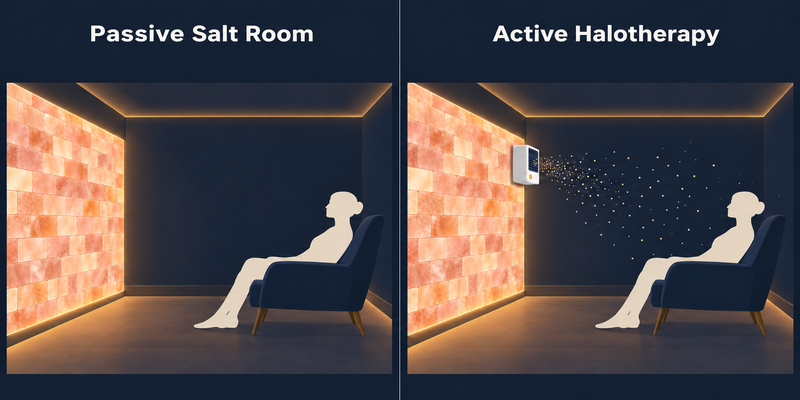
Important distinction: A room lined with Himalayan salt bricks is not automatically an active halotherapy chamber.
Cleveland Clinic describes two types. Active salt rooms use a halogenerator, a machine that disperses tiny dry salt particles into the air. Passive salt rooms use salt on walls or surfaces mainly to create the atmosphere.
Halotherapy research looks at the active kind. A passive room offers the look and feel of a salt environment, but not necessarily the same exposure. So we never treat the two as equal.
Himalayan Salt Room Benefits: What the Science Says
Himalayan Salt Therapy
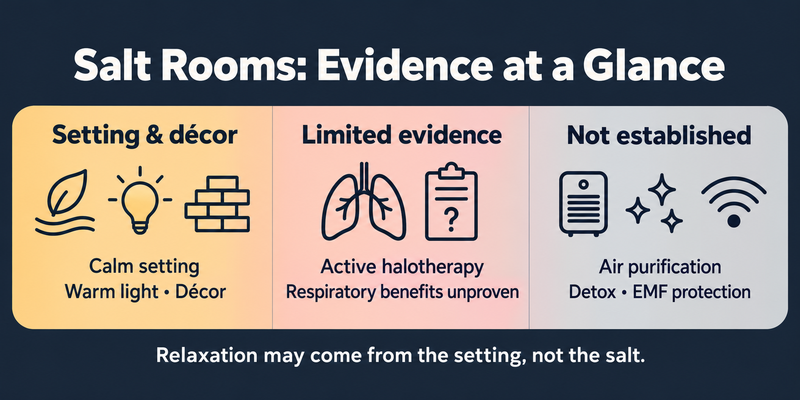
The benefits of Himalayan salt therapy are mostly studied through active halotherapy, also called dry salt therapy for breathing. Some small studies and reviews report possible respiratory benefits. Still, halotherapy effectiveness is unproven, and stronger trials are needed. For salt cave therapy for asthma, the evidence is insufficient. Never replace prescribed treatment with a salt room.
Benefits of a Himalayan Salt Room
The benefits of a Himalayan salt room are easiest to defend when they describe the environment. A quiet, softly lit space encourages rest, so salt room relaxation benefits are plausible. However, they likely come from the calm setting, not the salt itself. As for salt room respiratory health, there is little direct evidence for passive rooms.
Himalayan Salt Spa Benefits
Most Himalayan salt spa benefits relate to relaxation. A salt room gives you a warm, quiet place to switch off, which can feel like salt spa relaxation therapy or even salt spa stress relief. The feeling is real. Proof that the salt causes it is missing.
Himalayan Salt Wall Benefits
The main Himalayan salt wall benefits are decorative. A salt wall adds warm color, natural texture and a soft glow when backlit. Himalayan salt wall air purification claims are not established simply because a wall contains salt. Treat it as design, not an air filter.
Science vs. Marketing: Salt Room Health Claims
Use this table to check common salt room marketing claims and what the evidence supports.
| Topic | Common Marketing Claims | What the evidence shows |
| Breathing | Clears your lungs and improves breathing | Small studies on active halotherapy suggest possible benefits of some respiratory issues. Rigorous trails are still needed, and passive rooms are not the same exposure. |
| Asthma | Treats Asthma naturally | Evidence is insufficient. A salt room doesn’t replace prescribed treatment. |
| Skin | Heals eczema and balances your skin | Sound studies supporting this are lacking. |
| Stress | Salt melts stress away | A calm, quiet room can help you relax, but you can get the same effect without the salt. |
| Air Quality | Salt walls purify the air | A salt wall is not an air purifier. |
| Negative Ions | Releases healing negative ions | Not an established therapeutic mechanism. |
| EMF | Protects you from EMF | No credible basis. |
What We Know From Building Himalayan Salt Environments
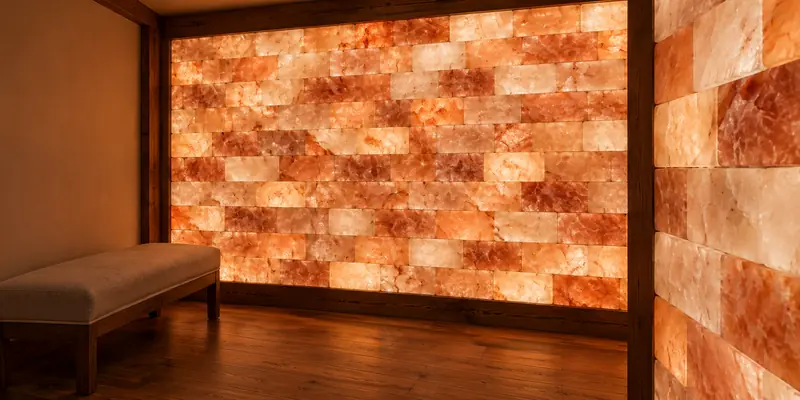
StarlineSalt supplies Himalayan salt bricks for salt rooms, spas, wellness centers, saunas and feature walls, with custom dimensions and natural variation in color and translucency. This work has taught us a few practical lessons.
- Brick selection: Natural tones vary across pink, peach, orange and reddish shades.
- Dimensions: Bricks can be cut to suit different architectural layouts.
- Backlighting: Translucency varies from brick to brick, which changes how an illuminated wall looks.
- Moisture: Salt is sensitive to humidity, so room conditions and installation planning matter.
- Structure: Interior salt surfaces need a proper frame, backing, lighting access and a maintenance plan.
- Replacement access: Lighting and electrical parts behind the wall should stay serviceable.
- Packaging: Salt bricks are heavy and brittle, so commercial projects need protective packing.
Safety and Realistic Expectations
Cleveland Clinic notes that salt rooms are generally considered safe for healthy people. Still, talk to your doctor first if you have an existing health condition, such as asthma or COPD, or if you are pregnant. Some people cough more afterward, and small rooms can feel tight if you dislike confined spaces. Standards vary, so choose a well-run spa. Enjoy the calm, but do not expect a cure.
Frequently Asked Questions
1. Is a Himalayan salt room good for you?
It can be a relaxing place to rest. Health benefits are not proven. Some research on active halotherapy shows possible respiratory benefits, but the evidence is limited. It does not replace medical care.
2. How long should you sit in a Himalayan salt room?
Spa sessions are commonly around 30 to 45 minutes. Follow your spa’s guidance, and leave if you feel unwell.
3. What are the benefits of a Himalayan salt wall?
Mostly visual: warm color, texture and a calm atmosphere. A salt wall is not an air purifier and is not the same as halotherapy.
4. Who should not use a salt room?
Talk to your doctor first if you have an existing health condition, such as asthma or COPD, or if you are pregnant. People who dislike small spaces may also find some rooms uncomfortable.
5. Should you shower after a salt room?
Spas differ, so follow your spa’s advice. A rinse can help if salt dust bothers your skin or hair.
Conclusion
Himalayan salt room benefits are real in one sense: the space can feel calm, warm and beautiful. Health benefits are far less certain, and they depend on whether the room is passive or active. Choose a salt room for the atmosphere, and ask your doctor about any medical goal.
Planning a salt wall or room? Browse our Himalayan salt bricks, or contact the StarlineSalt team for samples and advice on installation and upkeep.